宇宙から見た日食The 12 August 2026 eclipse from space, from the Moon's edge to Venus
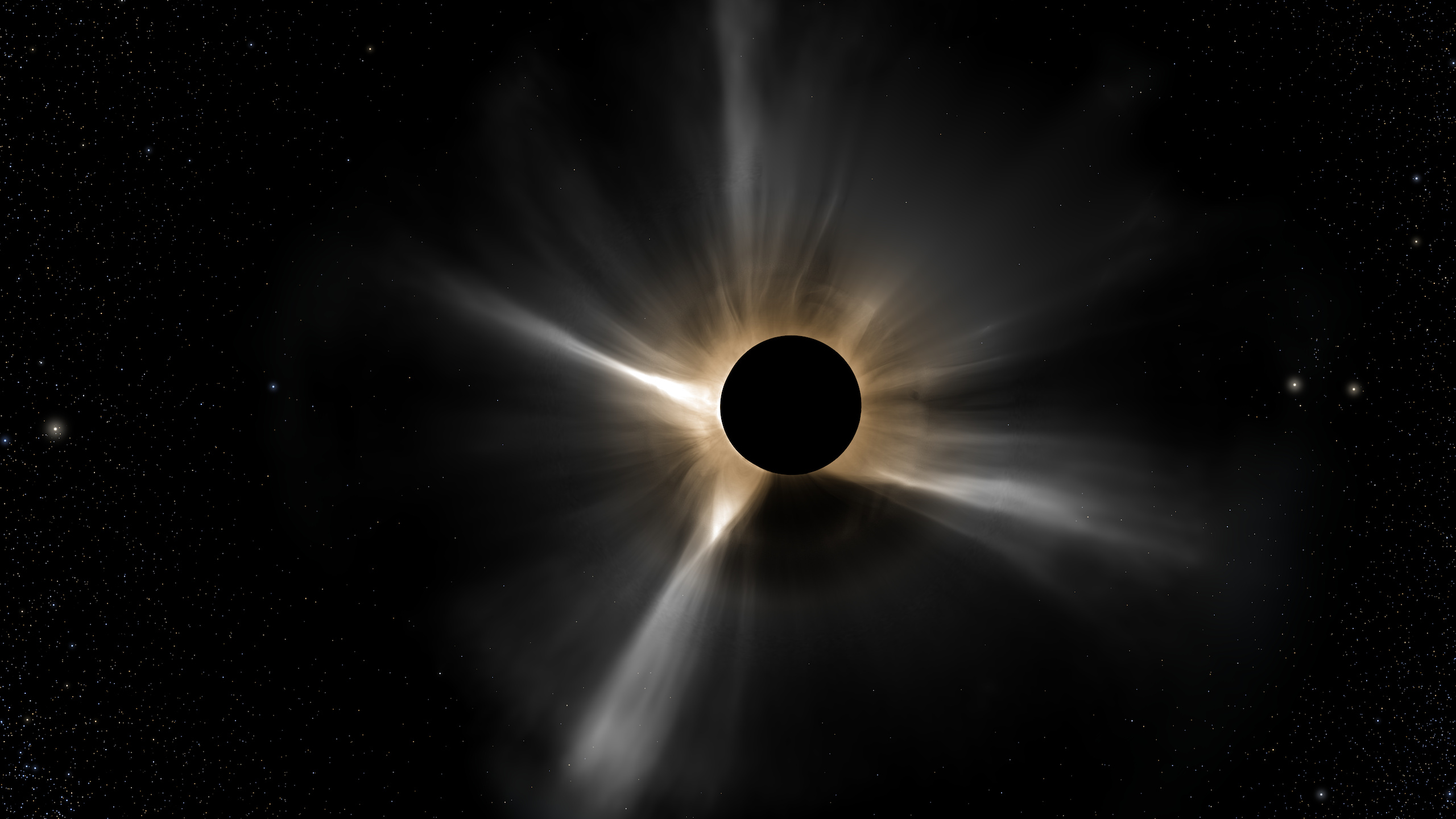
画像:ESA/Proba-3/ASPIICS(ROB)、SOHO/LASCO(ESA & NASA、NRL)、NASA/PUNCH(SwRI、SDAC)/画像処理:Stefano Ivan StingaImage: ESA/Proba-3/ASPIICS (ROB); SOHO/LASCO (ESA & NASA, NRL); NASA/PUNCH (SwRI, SDAC) · Processing: Stefano Ivan Stinga
ダウンロードDownloads
拡大画像Close-ups (full resolution crops)
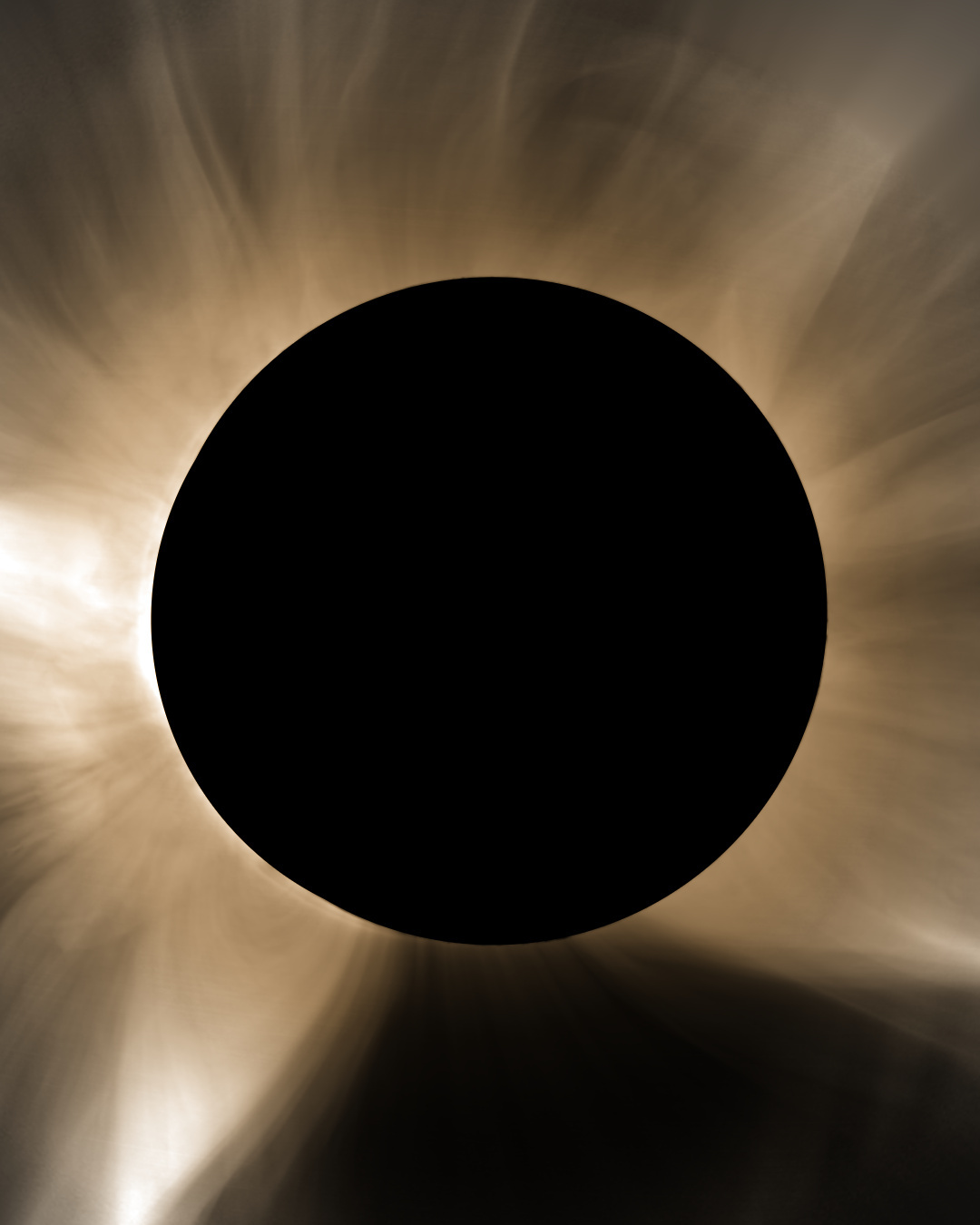
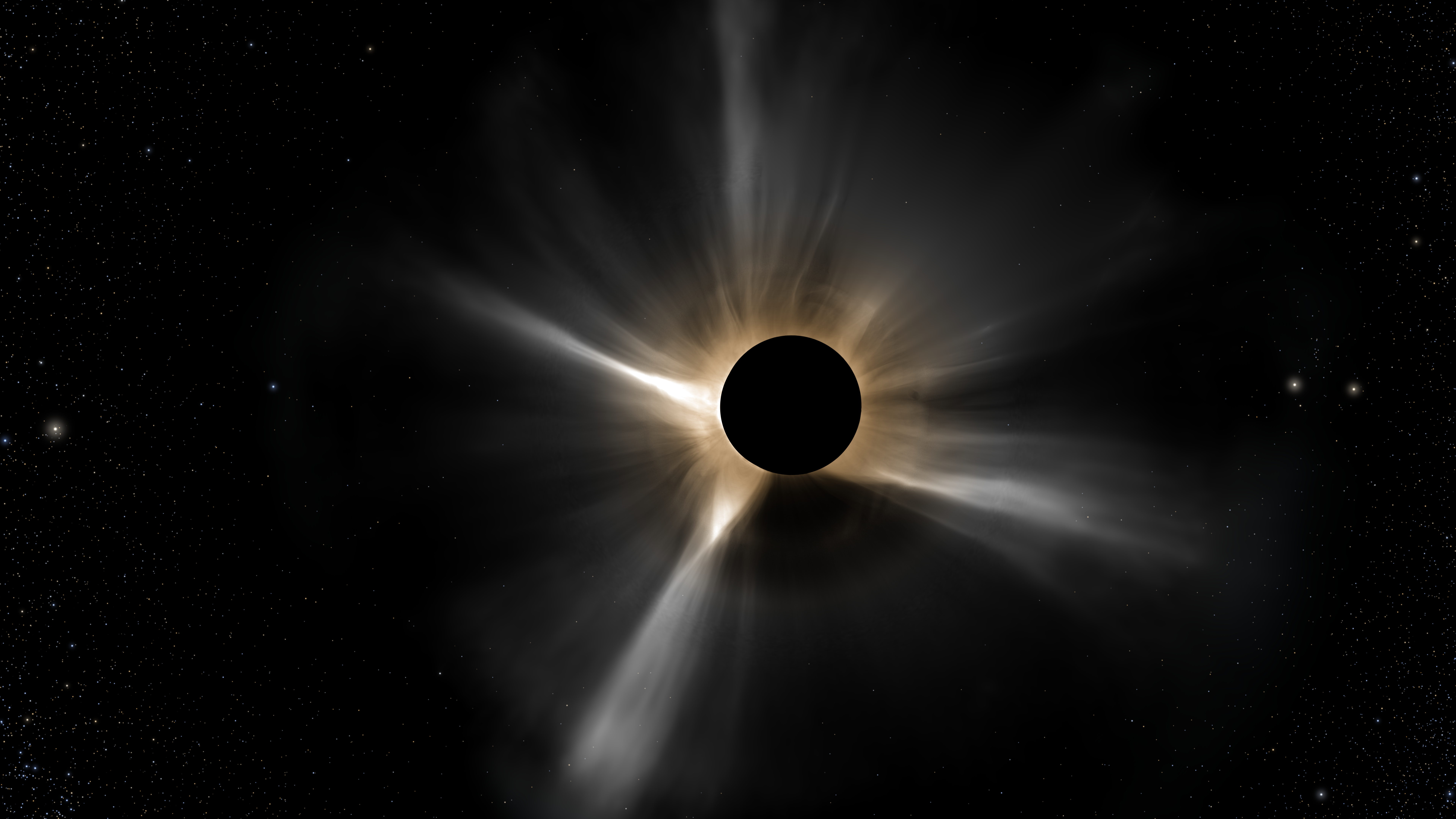
月と内部コロナ:プローバ3がとらえた、月の縁から太陽半径の約2倍までの細かな光条The Moon and the inner corona: Proba-3's fine rays from the Moon's edge out to about two solar radii
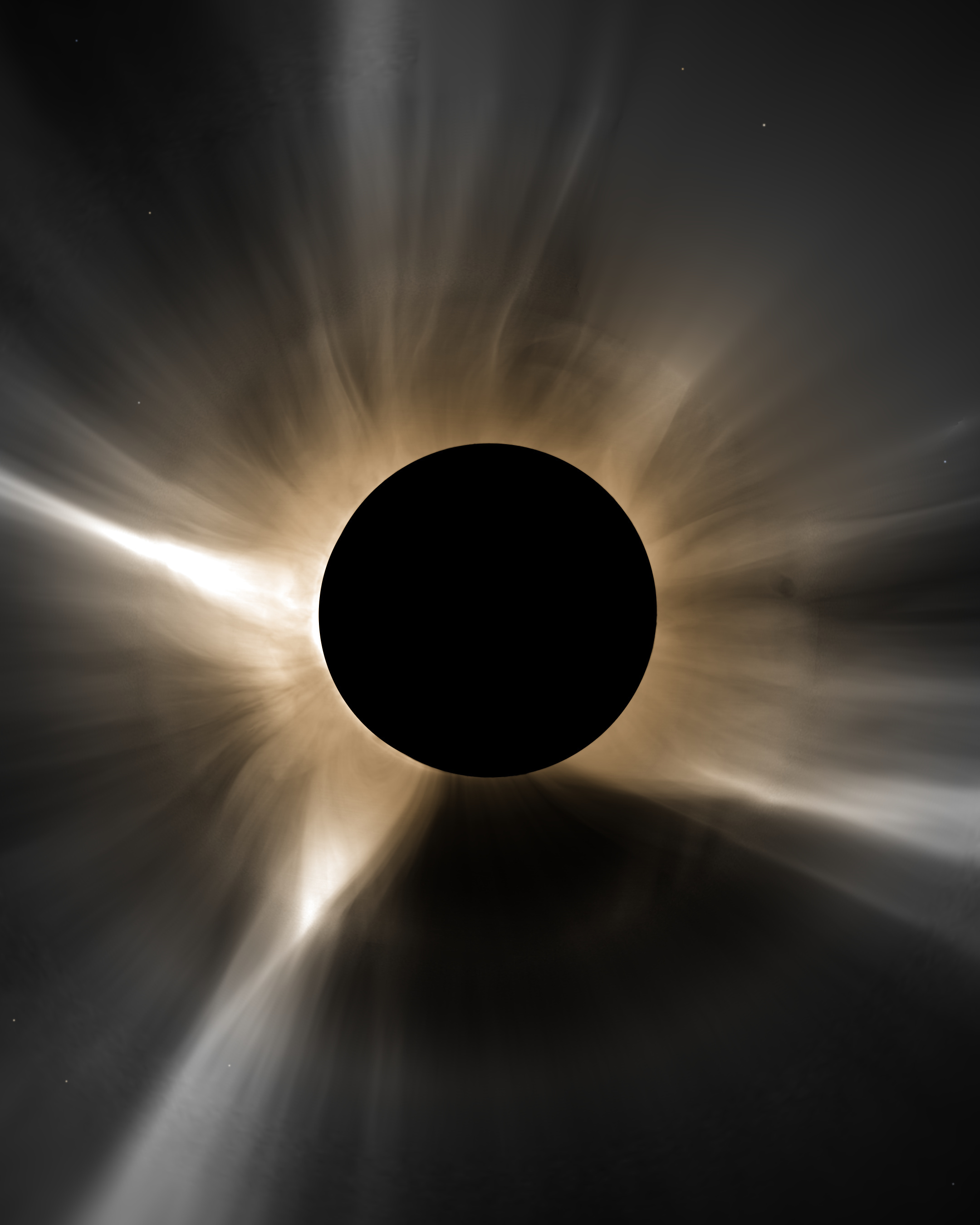
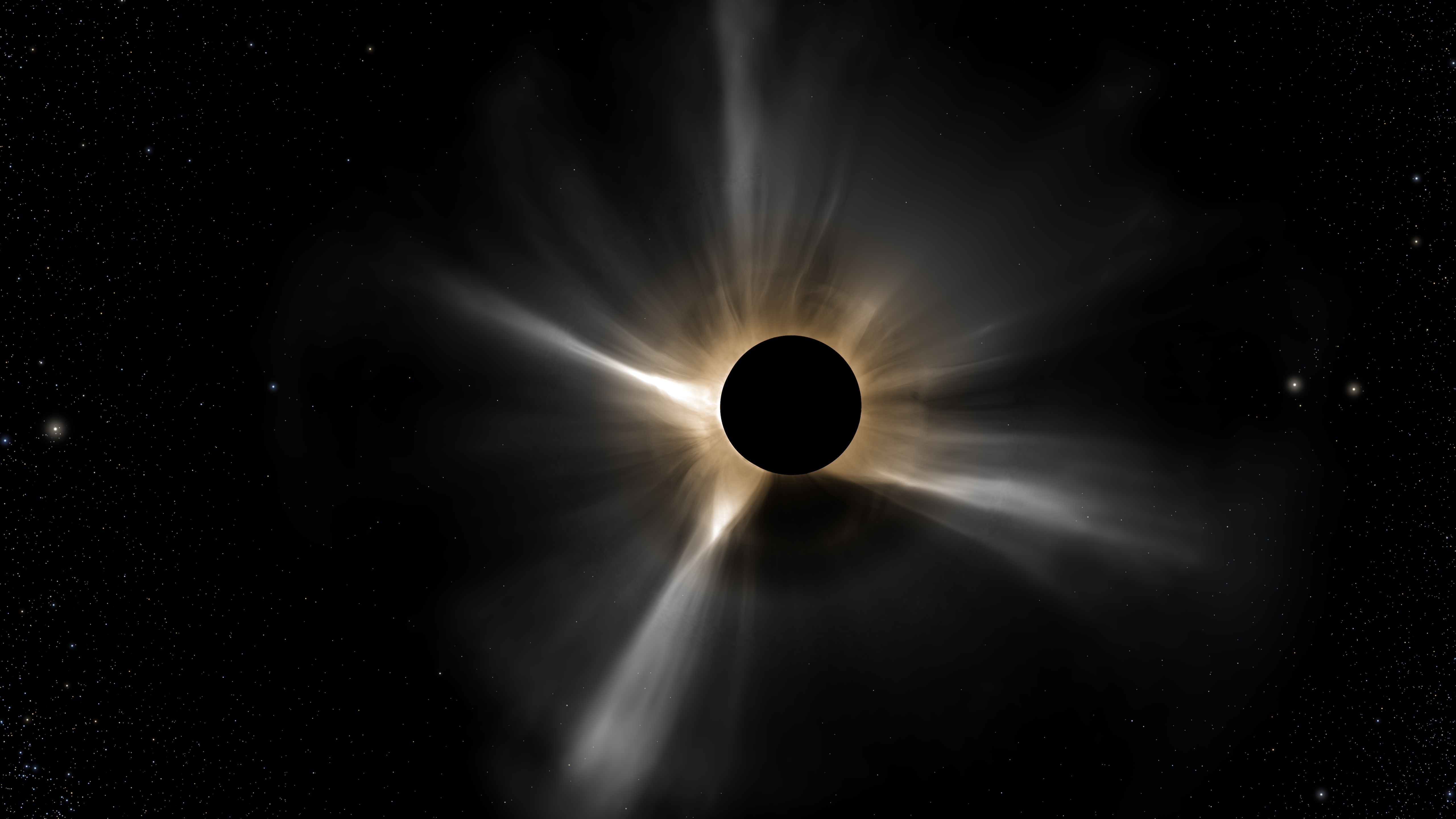
日食とストリーマーの根元:プローバ3の金色の内部コロナから、SOHO/LASCO C2の白いストリーマーへ。右上の滑らかな部分の一部は補間した扇形ですThe eclipse and the bases of the streamers: Proba-3's gold inner corona passing into SOHO/LASCO C2's white streamers; part of the smooth area at top right is the filled sector
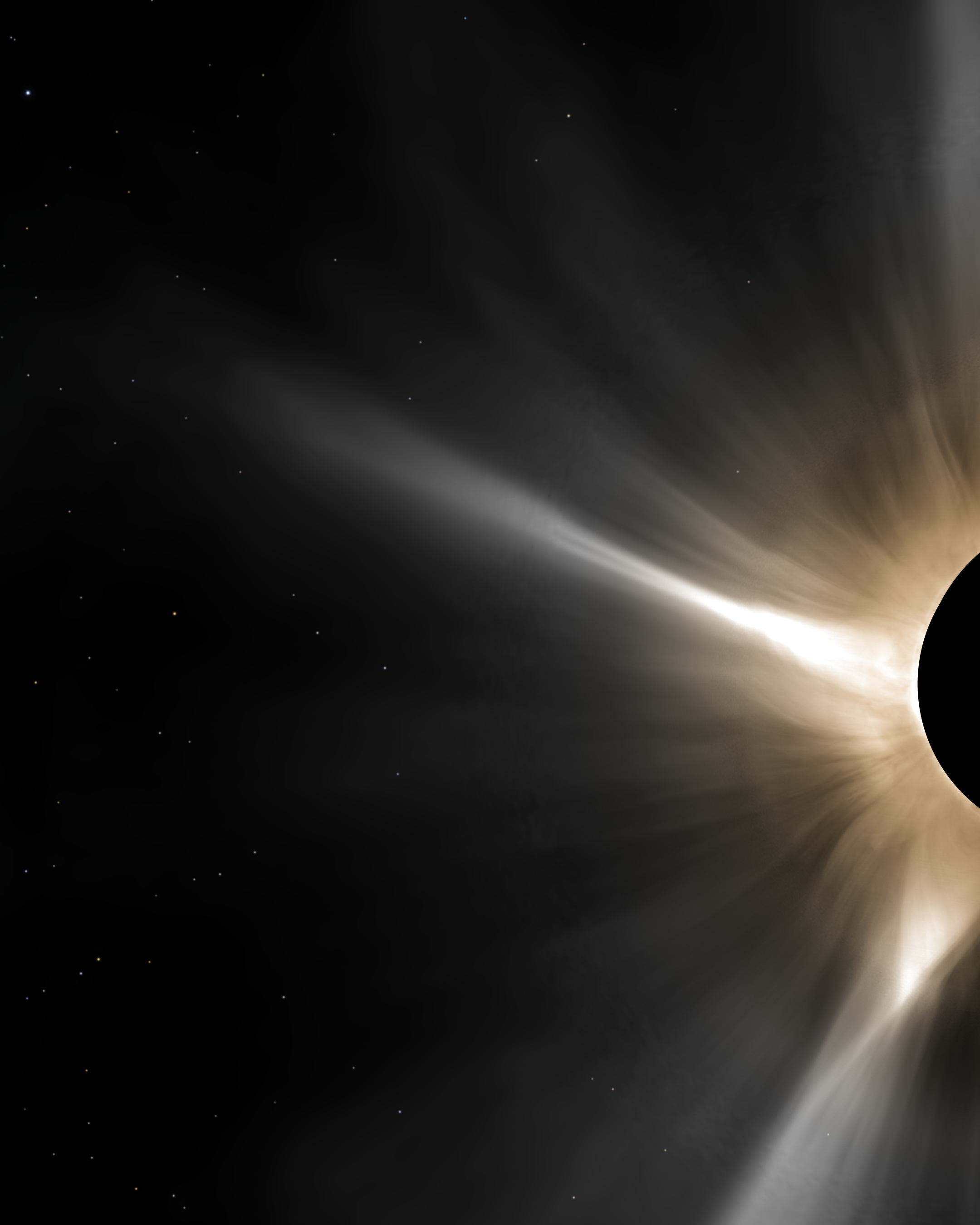
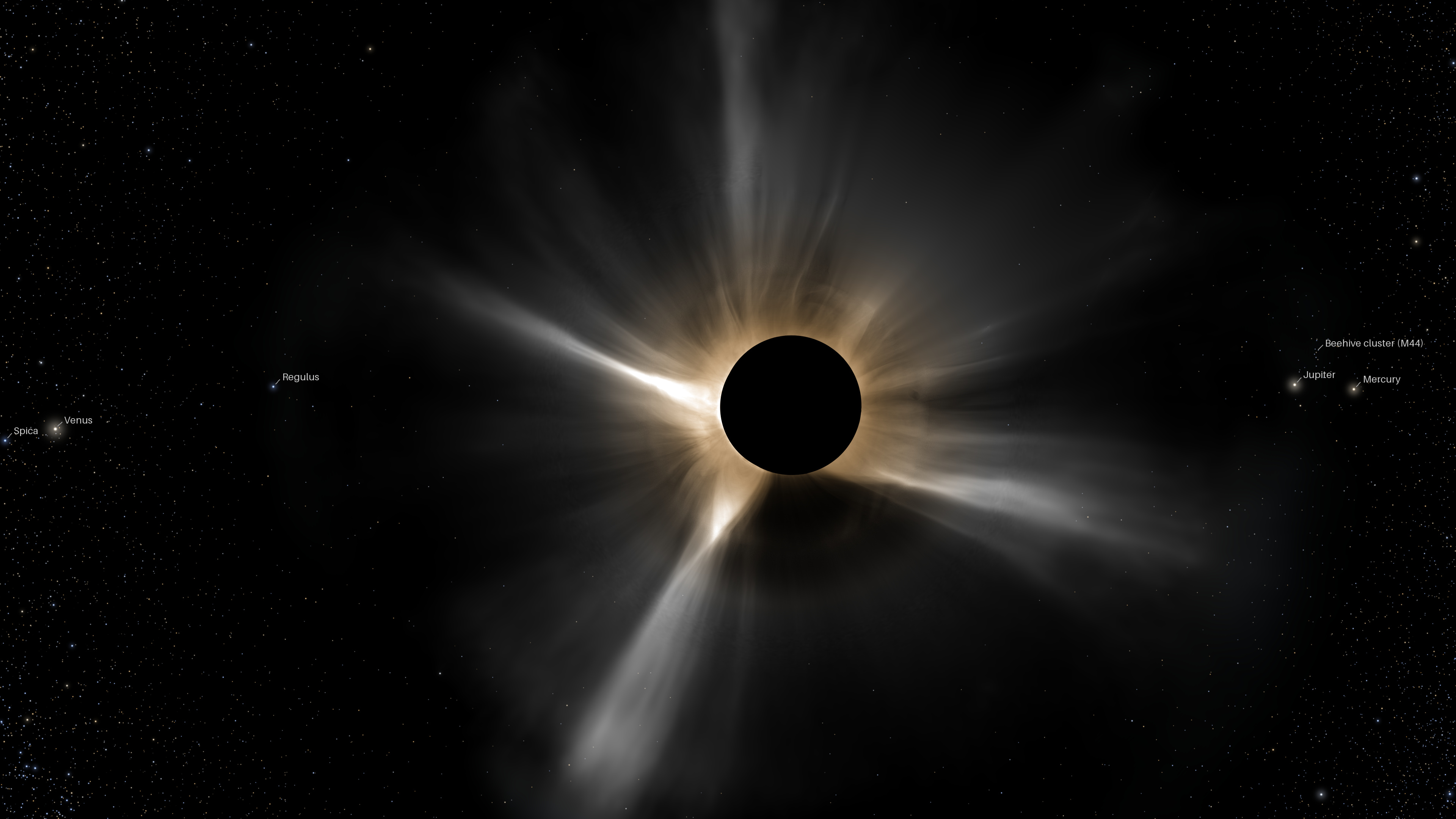
東側の明るいストリーマー:月の東の縁から外へのびるストリーマーと、星表から描いた星The bright streamer on the east side, reaching out from the Moon's eastern edge, with stars drawn from the catalogue
解説
2026年8月12日、地上で皆既日食が見られる約9時間前に、地球から約5万8000 km上空にいるESAの衛星プローバ3から見て、月が太陽の前を通過しました。プローバ3は編隊飛行する2機の衛星で、一方が太陽を隠し、もう一方のコロナグラフ(ASPIICS)が人工の日食の中でコロナを撮影します。その観測中に月も太陽を隠したため、ESAはこれを「二重の日食」と呼んでいます。この画像はその一瞬、08:40 UTCの姿です。プローバ3の画像に、約30分以内に撮影されたSOHO/LASCO(太陽と地球の間のラグランジュ点L1)とNASAのPUNCH(地球低軌道)の画像をつなぎ、月の縁から、太陽から46°離れた金星までのコロナを1枚にしました。黄道が水平に通り、左(東)に金星とレグルス、右(西)に木星と水星が並んでいます。
作り方
- プローバ3/ASPIICS(月の縁から太陽半径の約3倍まで):較正済みのレベル2データ。0.1・1・10秒の露出を1枚のハイダイナミックレンジ画像に合成し、17秒間隔の2組を平均
- SOHO/LASCO C2・C3(太陽半径の約25倍まで):約1か月分のフレームから作った背景(Fコロナ、迷光)で割り、時刻の近い3枚の中央値を使用。暗い外側は約1時間分の7枚の中央値
- PUNCH(その外側):レベル3の低ノイズ・モザイク(Fコロナと恒星はPUNCHのパイプラインで除去済み)
- 各装置の明るさは太陽からの距離ごとの平均に対する比で表し、重なる部分で隣の装置と合わせてつないでいます。距離による減光は強く圧縮して残しています
- 太陽の近くは実際の縮尺、遠くは対数的に圧縮して、日食と金星を1枚に収めています。方向は正確ですが、距離は縮尺どおりではありません
注記
- 色は表示上の選択です。データはモノクロで、本当のコロナは白色です。太陽からの距離を色で表し、太陽の近くは金色、中間(LASCOの範囲、太陽半径の約5〜25倍)は白、その外側(PUNCHの範囲)は青みがかっています。
- 北西の太陽半径約3〜21倍の扇形は、LASCO C2とC3の遮蔽板を支えるアームに隠れ、どの装置にもデータがありません。この部分(太陽半径2.5〜40倍の環の12.7%)は周囲とつながる滑らかな面で埋めており、柔らかいくさび形に見えます。
- 恒星はHYG星表v3.8から描いています(30,148個。この時間帯にPUNCHが記録した星の80%が星表の星と一致)。星の色はB−V色指数から求め、実際の1.5倍の強さで表示しています。水星・金星・木星はPUNCHの画像では飽和するため、計算した位置・明るさ・色で描いています。明るい点のまわりのにじみは表示効果です。
- ノイズはLASCOとPUNCHで外側ほど強く、主に放射方向に平滑化しています。PUNCHの恒星の残りを除き、惑星・明るい星とその飽和の筋、PUNCHから見えた月を隠し、太陽半径の40倍より外側の柔らかいむらを平らにしています。プローバ3の遮蔽板による影は画像から測って割り戻し、月の縁の数ピクセルは補間しています。月の円盤は黒く表示しています(その内側に記録されているのは月ではなく装置内の迷光です)。
- 複製(クローン)やAIによる生成はしておらず、コロナには何も加えていません。測光用ではなく、説明・鑑賞用の画像です。
- ソフトウェアとデータ、星や惑星を記録どおりに残し、補間・除去・平滑化をしていないデータのみの版:doi:10.5281/zenodo.23392795
About this image
On 12 August 2026, about nine hours before the total solar eclipse seen from Earth, the Moon passed in front of the Sun as seen from ESA's Proba-3, about 58,000 km above the Earth. Proba-3 is two spacecraft flying in formation: one blocks the Sun so that the other's coronagraph, ASPIICS, can image the corona in an artificial eclipse. The Moon covered the Sun while it was observing, which ESA called a "double eclipse". This is one moment of it, 08:40 UTC, joined with SOHO/LASCO (from the L1 point between the Sun and the Earth) and NASA's PUNCH (low Earth orbit), which recorded the outer corona within about half an hour: the corona from the Moon's edge out to Venus, 46° from the Sun. The ecliptic runs horizontally; Venus and Regulus are on the left (east), Jupiter and Mercury on the right (west).
How it was made
- Proba-3/ASPIICS, from the Moon's edge to about 3 solar radii: calibrated Level-2 frames; each set of 0.1, 1 and 10 s exposures merged into one high-dynamic-range image, and two sets 17 s apart averaged
- SOHO/LASCO C2 and C3, to about 25 solar radii: divided by a background built from about a month of frames (F corona, stray light); the median of the 3 frames nearest the moment, of 7 (about an hour) where the field is faint
- PUNCH, beyond: Level-3 low-noise mosaic (F corona and stars removed by the PUNCH pipeline)
- Each instrument's brightness is taken relative to its average at each distance from the Sun and matched to its neighbours where they overlap; the fade with distance is kept, strongly compressed
- Distance from the Sun is at true scale near the Sun and compressed logarithmically far out, so the eclipse and Venus fit in one frame: directions are true, distances are not to scale
Notes
- The colour is a display choice: the data are monochrome and the corona's true colour is white. Colour codes distance from the Sun: gold near the Sun, white in the middle corona (about 5–25 solar radii, LASCO's field), turning blue beyond (PUNCH's field).
- No instrument sees the north-west sector between about 3 and 21 solar radii at this moment: the arms holding LASCO C2's and C3's occulters both shade it. That sector (12.7% of the 2.5–40 solar-radii ring) is filled with a smooth surface that meets the corona on every side, and shows as a softer wedge.
- The stars are drawn from the HYG catalogue v3.8 (30,148 stars; 80% of the stars PUNCH recorded in these minutes match one). Their colours come from the B−V index, shown 1.5 times as strong as true. Mercury, Venus and Jupiter saturate PUNCH, so they are drawn at their computed positions, brightness and colour. The glow around bright points is a display effect.
- Noise is smoothed in LASCO and PUNCH, more far out and mostly along the radius. PUNCH's star residuals are cleaned; the planets, bright stars and their bleed trails, and the Moon as PUNCH saw it are masked; soft patches beyond 40 solar radii are flattened. Proba-3's occulter shading was measured on the image and divided out, and the last few pixels at the Moon's edge interpolated. The Moon's disc is shown black (inside it the instrument records its own stray light, not the Moon).
- Nothing was cloned or generated with AI, and nothing was added to the corona. For illustration, not photometry.
- Software, data and a data-only version of this view (stars and planets as recorded, nothing filled, cleaned or smoothed): doi:10.5281/zenodo.23392795
利用についてUse
報道・記事でのご利用は、上記のクレジットを表記いただければご自由にどうぞ。それ以外のご利用は CC BY-SA 4.0 の条件に従ってください。News and editorial use is welcome with the credit above. Other uses: CC BY-SA 4.0.
Flickr: original · X: @Sting1_JP · Bluesky: @sting1jp.bsky.social